It's 9:15 on a Friday night in Dubai. A family wants to book a dental check-up for Saturday morning. They call the clinic and nobody picks up. They send a WhatsApp message and get no answer. Then they open the next clinic on Google Maps, which replies in seconds, and they book there.
The first clinic did nothing wrong. Its receptionist went home at 6, exactly as their contract says. That's the problem an AI receptionist is built to solve. Not by replacing that receptionist, but by covering everything they can't.
This guide explains what an AI receptionist actually does, what it can't do, and how it compares with hiring front-desk staff or paying an answering service in the UAE. It also covers how to set one up so your customers never notice the handover between the AI and your team.
#What is an AI receptionist?
An AI receptionist is software that answers your customers on your behalf, on the phone and in messages, 24 hours a day. It answers questions from your own business information, takes bookings into your calendar, records the customer's details and passes the conversation to a person when one is needed.
You'll also hear it called a virtual receptionist or an AI front desk. The idea is the same: the first conversation with every customer is handled instantly, whatever the time and whatever the channel.
A modern AI receptionist usually covers:
- Phone calls: answering with a natural voice, booking appointments and transferring the call to your team.
- WhatsApp: where many customers in the Gulf prefer to book. Our WhatsApp chatbot guide covers this channel in depth.
- Website chat: for visitors comparing you with competitors.
- Instagram DMs and Facebook Messenger: for people who find you on social media or through your ads.
- Email: for the enquiries that still arrive at info@.
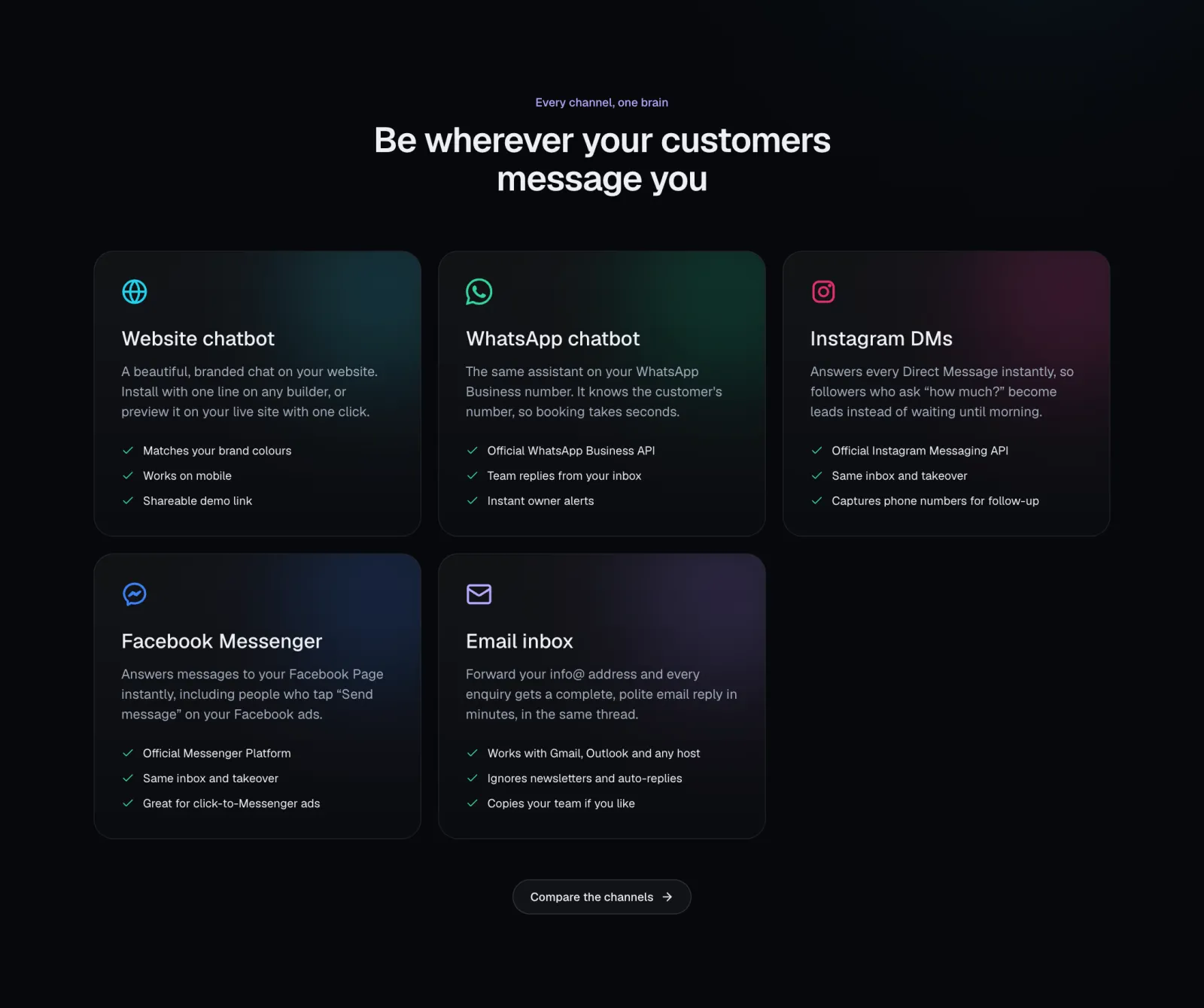 One AI receptionist, every channel your customers use
#The 120-hour gap: why one receptionist can't cover your week
Under the UAE Labour Law, normal working hours in the private sector are 8 hours a day or 48 hours a week. During Ramadan they drop by two hours a day. A week has 168 hours.
| Coverage | Hours covered per week | Share of the week |
|---|
| One full-time receptionist | 48 | 29% |
| Two receptionists on split shifts | about 96 | 57% |
| Round-the-clock human cover | 168 | 100%, but needs at least four full-time people once leave and sick days are counted |
| AI receptionist | 168 | 100% |
And those 48 hours aren't all available for answering. Your receptionist also greets walk-ins, handles payments, takes breaks, and gets 30 days of annual leave plus public holidays. Meanwhile, customers message and call when they are free: evenings, weekends, after iftar, and during your busiest hour when every line is already taken.
Most service businesses we speak to notice the same thing. A large share of enquiries arrives outside office hours, and those are the ones nobody answers until the next morning. By then, many customers have already booked with someone else.
#What an AI receptionist can do
A good AI receptionist learns your business from your website and the information you add: services, prices, opening hours, location, parking, policies. It answers from that and nothing else. When it doesn't know something, it says so, takes the customer's details and flags the question so you can add the answer once.
#Take bookings without double-booking
Connected to your calendar, it offers only genuinely free slots and confirms the booking instantly. If you'd rather confirm bookings personally, it can collect a complete booking request instead: date, time, service, number of people.
#Answer the phone and send a text when a caller hangs up
On calls, it answers with a natural voice, handles the same questions and bookings, and transfers the caller to your team when they ask for a person. If someone hangs up before speaking, it can text them back so the enquiry isn't lost.
#Speak your customers' language
In the UAE, the same afternoon can bring enquiries in English, Arabic, Hindi, Urdu and Russian. In messages, an AI receptionist replies in whatever language the customer writes in. On the phone, voice support is usually narrower. With Sahayok AI, for example, the phone receptionist speaks English and Gulf Arabic.
#Capture and sort leads
When a customer shows real interest, it asks for a name and phone number at the right moment. It then marks the lead hot, warm or cold so your team knows who to call first. You get an instant alert on your phone.
#Follow up and remind
On WhatsApp it can nudge customers who went quiet, send a reminder the day before a booking to cut no-shows, and ask for a rating afterwards.
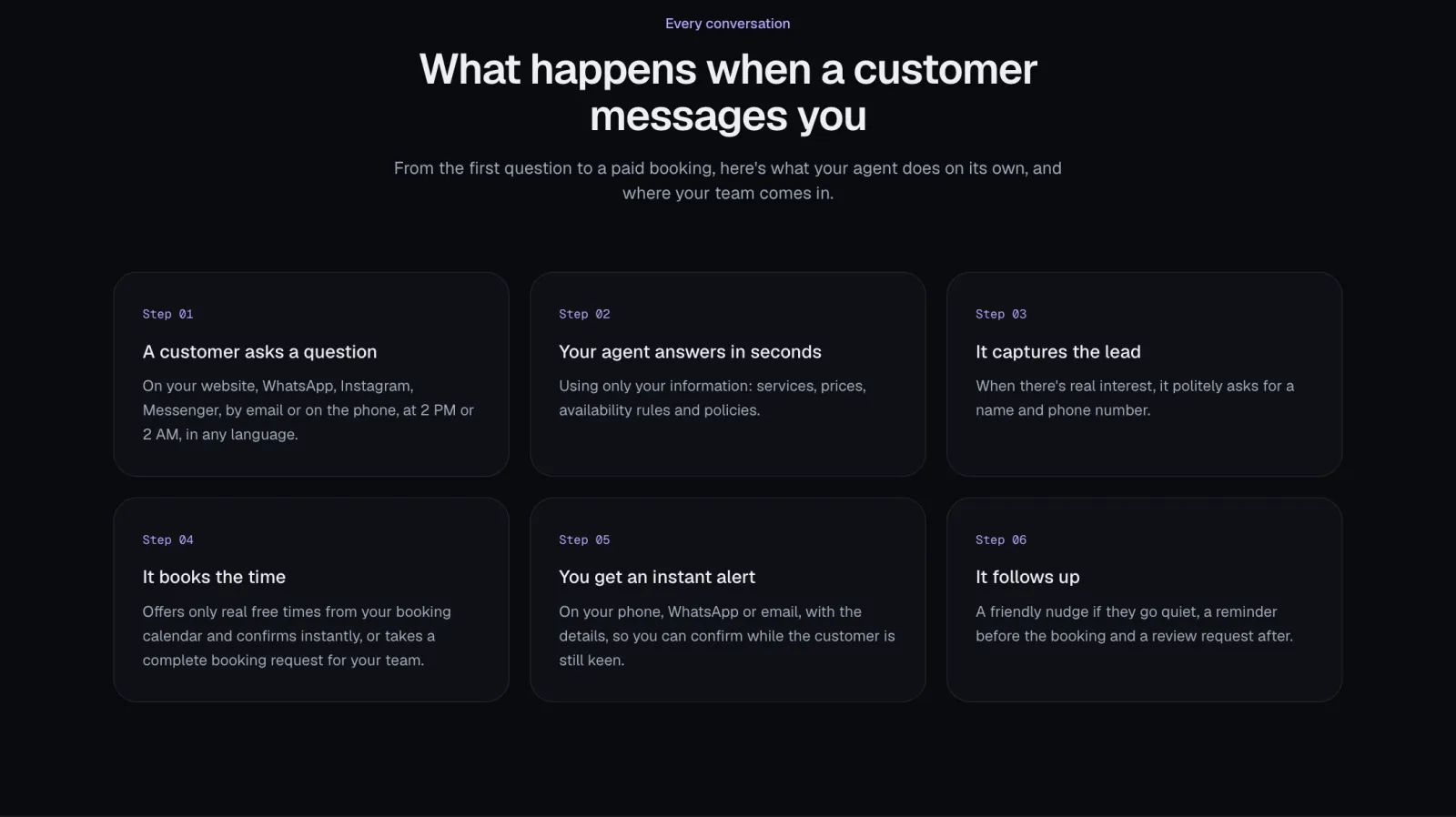 What the AI handles, and where your team steps in
#What an AI receptionist can't do (and shouldn't try)
We'd rather you know the limits before you buy than find them afterwards.
- It can't read the room at your front desk. Walk-ins, a nervous patient, a VIP client who expects to be recognised: that's human work.
- It shouldn't make judgement calls. Medical advice, legal or mortgage questions, refunds outside your policy, negotiating a discount. A well-built AI receptionist is told never to do these and hands over instead.
- It only knows what you tell it. If your prices aren't written down anywhere, it can't quote them. The quality of its answers depends on the quality of your information.
- It shouldn't pretend to be human. Customers should know they're talking to an assistant. Most people don't mind when they get a fast, useful answer and can reach a person at any time.
- It doesn't replace the relationship. It wins you the first reply. Your team still wins the customer.
#Human receptionist vs answering service vs AI receptionist
There are three realistic ways to make sure customers get an answer. Here's how they compare for a typical small or medium business in the UAE.
| In-house receptionist | Outsourced answering service | AI receptionist |
|---|
| Hours | Your office hours (up to 48 a week per person) | Often 24/7, depending on the package | 24/7 |
| Channels | Phone, walk-ins, plus messages when they have time | Mostly phone | Phone, WhatsApp, website chat, Instagram, Messenger, email |
| Languages | Whatever that person speaks | Depends on the provider | Replies in the customer's language in messages; voice is usually a smaller set |
| Can book into your calendar | Yes | Often takes a message instead | Yes |
| Knows your business deeply | Yes, over time | Works from a script | Yes, from your website and the knowledge you add |
| Handles complaints and judgement calls | Yes | Limited | No: hands over to your team |
| Busy-hour capacity | One conversation at a time | Depends on the provider | Many conversations at once |
| Cost | Monthly salary plus employment costs | Monthly fee or per minute / per call | Monthly subscription |
The honest takeaway: none of the three does everything. Human receptionists are best at people and judgement. Answering services fill phone gaps but rarely book or follow up. AI receptionists cover every hour and every channel at once, but they need a human behind them.
#What a receptionist really costs in the UAE
Salary is only the start. On UAE job boards, most Dubai receptionist roles are advertised at roughly AED 4,000 to 7,000 a month. Admin-heavy or corporate front-desk roles pay more. On top of salary, an employer in the UAE typically covers:
- Visa, Emirates ID and medical test fees for expatriate staff, plus renewals.
- Health insurance, which employers must provide for private-sector staff.
- End-of-service gratuity: 21 days' basic salary for each year of service in the first five years, rising to 30 days a year after that. Set aside about 6% of basic salary every month.
- 30 days of paid annual leave a year, plus public holidays, when someone else has to cover the desk.
- Overtime if they work beyond normal hours.
- Recruitment and training time, again each time someone leaves.
A quick way to estimate your own number:
Monthly cost of one receptionist ≈ salary + (yearly visa, insurance and recruitment costs ÷ 12) + 6% of basic salary for gratuity
Then divide by the hours they actually spend answering customers. It's usually far more per conversation than owners expect. And it still leaves the evenings, weekends and busy-hour overflow uncovered.
An AI receptionist is a flat monthly subscription with no visa, leave or gratuity. Many platforms have a free plan to try it on your website first. You can see Sahayok AI's plans on our pricing page. The phone receptionist is part of the Pro plan.
See what your own AI receptionist would say. Paste your website and chat with it in about five minutes. Free to start, no card needed.
Create your free agent How it works
#AI receptionist vs chatbot: what's the difference?
Older chatbots were button menus: "Press 1 for prices, 2 for opening hours." They couldn't understand a real question and they couldn't do anything.
An AI receptionist is different in three ways:
- It understands natural questions, including typos, voice notes and mixed languages.
- It takes actions: books the appointment, records the lead, alerts your team, transfers the call.
- It works across channels with the same knowledge, so the customer gets the same answer on the phone as on WhatsApp.
If you want to see how this plays out in specific businesses, our guide to the AI chatbot for small business walks through ten real use cases with example conversations.
#The setup that works best: AI first, humans for the moments that matter
The businesses that get the most from an AI receptionist don't use it to cut staff. They use it to change what their staff spend time on.
- The AI handles the first reply, the repeated questions, out-of-hours enquiries, booking, reminders and the overflow when the phones are busy.
- Your team handles the hot leads the AI flags, complaints, walk-ins, complex quotes and anyone who asks for a person.
- One shared inbox shows every conversation from every channel, so anyone on your team can take over a chat at any moment and the AI steps back.
What this looks like in practice depends on the business:
#A note from the author
[PLACEHOLDER: replace with a short, true example from your own experience, or delete this section. Write it in the first person and keep it to 3–5 sentences. A good example names the type of business (not the client), the problem you saw (for example, ad leads arriving at night and going unanswered), what changed, and an honest result. Don't invent numbers.]
#How to choose an AI receptionist
Before you sign up for any tool, check these eight things:
- Does it answer only from your information? Ask it something that isn't on your website and see whether it invents an answer or admits it doesn't know.
- Does it hand over cleanly? You should be able to take over any conversation, and callers should be transferable to a person.
- Does it cover the channels your customers actually use? In the Gulf, that almost always means WhatsApp.
- Does it use the official platforms? WhatsApp, Instagram and Messenger should connect through Meta's official APIs. Tools that log in with your password risk getting your account blocked.
- How does it handle Arabic? Test it in Gulf dialect, not just formal Arabic, and check which languages the phone voice supports.
- Can it book for real? It should read your availability, not just collect a request you have to confirm by hand (unless that's what you want).
- How does it handle customer data? Look for data export, deletion on request and alignment with the UAE data protection law (PDPL).
- Can you try it free? You should be able to test it on your own business before you pay.
#How to set one up in a week
You don't need a developer. A realistic plan:
- Day 1: Connect your website so the AI learns your services, prices and hours. Read through what it learned and fix any gaps.
- Day 2: Add the answers to your ten most common questions, plus anything that isn't on your website: cancellation rules, parking, payment methods.
- Day 3: Choose the tone and the rules: what it should always collect, and what it must never promise.
- Day 4: Test it like a customer, in every language your customers use. Try to trip it up.
- Day 5: Put it live on your website, then connect WhatsApp.
- Day 6: Connect Instagram and, if you need it, the phone.
- Day 7: Turn on alerts on your phone, then review the first conversations and the list of questions it couldn't answer.
For the step-by-step version with screenshots, see how it works. If you'd rather not do it yourself, our team can set it up for you.
#The bottom line
A receptionist is one of the most valuable people in a service business, and one person can't be available 168 hours a week. An AI receptionist covers the other 120: the evenings, the weekends, the busy hour and the languages nobody on your team speaks. It hands every real decision back to your people.
Start by letting it answer on your website. Watch what it does with your customers' questions for a week, then decide how far to take it.
Your next customer might be calling after hours. Make sure they get an answer, and you get the booking. Start free and go live on your website in about five minutes.
Start free See all features
Every article is written by people who build and support Sahayok AI, and checked before it is published. How we write and review